And what can be said...This exhibition is not only a great opportunity,
it's the closure of an amazing year here in Sweden, I've experienced and
seen a lot of things, both good and bad, I've truly evolved myself, and
to resume everything in this exhibition is more than wonderful...
So, tack så mycket!"
"What is not seen" is a small video-art that I made with all the extra footage that I took for a documentary course. When I
was shooting the interviews, I'd usually leave the
camera switched on, sometimes on purpose, sometimes by mistake, but they
weren't aware of it, so what was captured is how they really are and
behave when they don't have to act...it's usually what we never get to
see when we watch a movie or a video.
This is the final piece of a project which I developed during the year I
stayed in Sweden as an erasmus. The project theme was identity: what
makes a person different? what makes each person special? what is
an identity made of? why do we have the need to be so unique, yet so
integrated in a group? what do we use to define our identity? this are
some of the questions that define the proyect.
This is the last sculpture I've made up until now, and was the end of my to erasmus and my art studies. It's a self-identity, a piece meant to represent my identity.
Reaching this point was really difficult, I tried to achieveit for months. I found quite hard to summarize my identity in a single
image/piece. When I started looking at my own identity, I found out
that there was so much I should represent, so many different things,
aspects of my life, that I didn't know how I should start...First I
tried to think about it out of the blue, but that only lead me to think
about my personality and my relation with society, leaving out some
important things. Then I decided to change my strategy, and tried to
think about it by parts, but that didn't help much either. Anyway, that set me on the right way, as I started learning
things about myself. I finally started writting everything down, giving
it shape, and listing all the different aspects of my identity...with
all that learnt and in my mind, I ended up creating this design
It works as a whole thing, everything is conected and moving,
flowing...I feel this piece represents everything that I am right now at
this point of my life, I feel identified with it.
To make this piece I had to go back to Spain, the installations here in Sweden were too small to make this.
The process of bronze casting a piece like this is quite long, first of
all, I had to make a plaster cast of a ball, then in two pieces, make
with it the two sides of the ball with wax, as it's empty on the inside,
I had to do it aplying thin layers of wax. Once I had the teo sides of
the wax ball, with a hot iron I started making the different holes on
it, and refining the borders.
Once the ball was ready on itself, I had to add a lot of wax pipes which
will be used later to let the molten bronze in, I also had to add some
air exits. When the pipes are ready, the whole wax piece goes inside a
block of plaster mixed with brick powder, and when it has dried, it's
placed inside a hoven. Then, all the wax melts and goes away, leaving a
block which has inside the shape the piece and the pipes had.
That leads to the video, the block is placed in sand, because if
something goes gronw it could explode, then, with the bronze molten at
1200 Cº, we pour it inside the pipes, as the video shows, I also worked
on this, the first two blocks contain this piece. When the bronze has
cooled down, the plaster block is destroyed, and if everything goes well
(which is not so common), the piece is almost finished, there is only
left removing the pipes, as the first two pictures show, and then
polishing it
I think it's quite funny, how this piece, which is about my own
identity, is the project where I recieved most help in my artistic life,
I had the colaboration of several teachers and lots of
friends in order to finish it and be able to bring it to Sweden on
time...I believe, that this process and how I was helped really suits
the piece.
Back in Sweden, I polished both outside and inside the sphere, but I realized that polishing the wholes was really hard as the only way was using small rasps, so the piece made it to the art exhibition unfinished. It took me another year and a half to completely finish it, as I was busy with design and VFX courses.
Harder, Better, Faster, Stronger Birch wood 50 x 30 x 30 cm. Apr. 2012
This is the fifth piece of a project which I developed during the year I
stayed in Sweden as an erasmus. The project theme was identity: what
makes a person different? what makes each person special? what is
an identity made of? why do we have the need to be so unique, yet so
integrated in a group? what do we use to define our identity? this are
some of the questions that define the proyect.
Groups also have identities, and have a huge rol in our society
nowadays. We are social beings, we are small pieces of society, we need it to
survive, to have all our needs covered, to be part of it we work, we
have friends, we consume...and we make it work. A single person usually
wont go too far, even behind the greatest personalities in history there
is a lot of people working for them...That explains the shape of this
sculpture, all the pieces together can rise higher, they are stronger
and can achieve things that a single piece couldn't...a single piece
would never be able to be a single spike
On the other hand, the spikes themselves have their own identity, as
groups do...from bussiness, companies, political parties, even
countries.When we think about them, they have their own
atributes and do what we alone can't.
The piece is composed of lots of small wooden pieces, as a puzzle. I gave each spike it's shape, and then when it was polished, cut it in
small pieces and glue it again. When all the spikes were ready, I glued
them together and repeated the process with the lower zone.
Foundations Pinewood and birch wood 50 x 20 x 20 cm. Jan. - Feb. 2012
This is the second piece of a project which I developed during the year I
stayed in Sweden as an erasmus. The project theme was identity: what
makes a person different? what makes each person special? what is
an identity made of? why do we have the need to be so unique, yet so
integrated in a group? what do we use to define our identity? this are
some of the questions that define the proyect.
An identity can't be created on your own. Afterall, your identity
defines yourself in front of other people, it's what distinguishes you.
Therefore, as an identity has a social component, it's only natural that
society has an influence over it.
That's what this proyect is
about, how an identity is greatly defined by society. Starting from
where you are born, or where you've travelled, that gives you a
language, which already makes your way of looking at the world
subjective; that also applies to your culture, what you were taught at
school, where do you live...
But it's also focused on how people
influence you: your tastes, your ideas, your way of knowing the world is
also marked by people, maybe they are people who you met only once, or
your teachers, or your firends or family. Maybe they influenced you in a
positive way, maybe as an opposite reaction of what you don't want to
do or be, but everything and everyone influences you.
Made of a trunk on it's upper zone, and with different kinds
of wood in the base, this different pieces of wood are the support of
the upper piece, which is massif in contrast with all the small pieces
of different woods which support it. The trunk wouldn't be able to
sustain itself without the smaller pieces, just as nobody has an
identity without the help and the influence of other people. I made this sculpture breaking all the guidelines I was given on my
previous years of studies: gluing the wood pieces "against fiber", and
giving them colour and wax coating before sculpting the upper zone, also
gluing those pieces to a massive trunk. I encountered some problems but I also I learnt how to use the big machines, that are forbidden for students in
Spain, I got to colour wood with anilines for the first time, I
experienced with difficult gluings, and carved for the first time a
trunk.
The Mirror Iron 50 x 50 x 5 cm. Nov. 2011 - Jan 2012
This is the first piece of a project which I developed during the year I stayed in Sweden as an erasmus. The project theme was identity: what makes a person different? what makes each person special? what is
an identity made of? why do we have the need to be so unique, yet so
integrated in a group? what do we use to define our identity? this are
some of the questions that define the proyect.
Back then I had a diary blog, where I posted all of my thoughts, research and progress on this project:
"Recently, when I go out to party, I've been noticing something that I
found quite funny, but also quite interesting: how everybody is doing
their best to look as good, beautiful, sexy, etc as possible, making
efforts to look like intelligent, funny and interesting people...
The
reasons each one have are up to themselves (searching for friends/
hooking up / having fun), but it got me thinking about how we try to
disguise ourselves, that image we are generating is only a really small
piece of all our identity, and in some cases, it's not even that, it's a
lie. It also works in the opposite way: how can you know that a person
you just met is being him/herself? As you get to know a person better,
you usually notice that they aren't as marvellous as the originally
looked like...They have bad days, they aren't always that
funny/intelligent/etc, they aren't as good looking as they were, etc..."
That is the motivation of this piece: first impressions and how we manipulate them. I made an iron mirror very reflective in it's central zone, as in the first impressions, and then, towards the borders, it gets opaque, cracked, rusted, just as it happens when you meet a person: at first, you'll see the
image he or she wants to give, it's a deformed image, but quite flashy
and clear, then, as you get to know him or her better, you start to
notice the rusty parts, the cracks, their imperfections that makes
them human.
This piece is an introduction to the whole proyect, simply looking at
it, you'll see your deformed image, which leads to think about who are
you and what is the image you are trying to give to other people, the whole piece it's considered a mirror, although you won't be able to see yourself on all it's surface.
I used iron plates and welded them with a gas mixture welder. When the
whole structure was welded, I burnt and melt the borders to make them
uneven, and used the heat from that to rust the piece. I welded the central zones and polished them with a grinding disc so the
central zone would have a greater fade, and would look more like a
single piece instead of several iron plates put together. The piece itself didn't turn out to be exactly as I planned at first, I
found several problems with the welding process, as the plates were too
thin for the techniques I was using on them, they melted, deformed and
behaved in different and weird ways, which I had to deal with and adapt
to the idea. On the other hand, I found really interesting and useful
learning about gas welding.
Brain Coral Forged Iron 30 x 50 x 30 cm. Jan. - Jun. 2011
One of my teachers prompted me to try forge. It was a technique I had
never tried before, and it infuses respect, as you are working
with fire and iron, in Fine Arts there's few people who tries
forging to make a piece.
This is the first piece I made
improvising, as my teacher's advice was to buy iron and start practicing
with it, to see how it works and learn about different techniques.
Therefore I started to give different shapes to the iron rods I got, and
found particulary interesting trying to reach the iron's limit of
bending. Each day, I'd start working with a straight iron rod of 1
meter, and bend it as many times as posible, making it as compacted as
posible. As a result I started to pile up pieces of bent iron as big as a
hand, and the idea of forming a shape from all of them eventually came
to my head. Each iron rod had a different shape, as I was never able to
decide it's final shape, It came by itself with the bending.
Finally,
I got 20 pieces and welded them toghether in several semicircles, and
then, I welded them together, and rusted them with some chemical
products and fire.
It doesn't have a lot of concept, but it was a
great way of trying another way of working, feeling how the piece grows
by itself with time and effort, without any plan, leaving everything to
improvisation. Also, I learnt a lot of forging, from starting a fire,
controlling the heat it produces, where is the heat located or where are
the iron limits before it break.
The idea of this project came from a personal experience, the growth of
my wisdom teeth. This got me thinking in how growing up is an inherent
part of everyone's life, how it's linked to wisdom, such as growing some
teeth supposedly is a prove of wisdom and maturity, but also, how
growing also means pain and finally death, and how we don't have any
control over it.
The sculpture seeks movement, as growing up
always mean moving forward, but also the pain it carries with it. The
form is based on a tooth, mixed with movement. The alabaster this time was a big surprise, as its almost green, it also has lots of streaks and different densities, which made the process a bit more complicated.
Technically, I learnt a lot about using mechanical
tools, as up until this point, everything I made is mostly done with
traditional tools. I worked with a really limited schedule, as I only
had month left to develop a project...so working with mechanical tools
was mandatory to finish it on time. Mechanical tools supposed a great
speed up, and the piece was made in one week, with 20 hours
of work from the raw stone to the final polish.
Ideas birch wood 60 x 150 x 100 cm. Oct. 2010 - Jun. 2011
This is one of the most complicated projects I've ever made, and includes concepts and techniques which I had learnt in the previous projects.
The concept is based on the "ideas" by themselves: how are they born, how do they grow, expand and evolve. The piece is made of wood as it is an organical and "alive" material, the main concerns are the balance and the space where the sculpture stands, as it has lots of outer and inner spaces (the concept which I previously worked on the resin sphere). The base only has 20 x 20 cm. and it sustains a central pillar which holds 11 pieces, which balance the sculpture. Each piece has it's upper part polished, and the lower part maintains a raw look.
An idea is born from something small, a thought, an image, a sensation. Then it grows and expands, generating different versions of the first idea, the balance and the disctintion between inner and outer space is to represent the relationship that stands between the mental idea and the real world and it's materialization.
Technically, it has been one of the most challenging pieces I've ever made, this time I wanted to test my limits, it was a lot of planning, as I had to make each piece separatedly and then glue them together and keep sculpting. The size and weight the whole piece has made it really difficult, and towards de end I had to use a grinding disc for the first time.
I think this proyect summarizes well my way of working, it has
everything I seek when I work, and also reflects well my evolution since
I started studying arts
Cara de Hierro Iron and old keys 40 x 30 x 30 cm. Jun. - Nov. 2010
Related to the anatomy studies I took on my third year of Fine Arts, the idea of this sculpture was based on the face muscles, I wanted to make a piece which gave the sensation of moving fibers, as if each iron wire was moving to complete the face. I also wanted to drive the attention towards some of the most powerful
features of the human face...The supposed simmetry (as it really doesn't
exist) and the eyes
To make this piece, I made a casting of a friend's face, and used it as some kind of guide, but my intention was that the piece doesn't resemble her at all, I only needed a starting point. I learnt welding while working with this piece, it was quite hard as the iron rods are really thin, its thick wire, if I was not careful I'd melt and break them.
The hair, wich is one of the things we
notice first when looking at someones face, was originally intended to be made of iron wire, but by chance I got a lot of old keys from an old locksmith, they are all the defective keys he had produced over the years. I thought it would be more interesting to add them as the hair.
Hand Forest Plaster 30 x 60 x 60 cm. Mar. - May 2010
This piece, composed of 10 hands and roughly 250 fingers is a reflection on hands, and all the power and meaning they have: hands are one of the most used parts of the human body, and they also hold a lot of meanings and have been present in art representations since prehistory, not to talk about body language, all the things we express through gesticulation, or the deaf-mute language and it's variations.
Using alginate, a powder made from japanesse seaweed, which can create
the most exact casts, I casted some family and friends hands and
fingers, in order to create a piece completely made of hands and
fingers. Each one was asked to make a random gesture, or the one they'd like the most, this reflects different meanings and expresions, It's possible to
recognize how do they use their hands, how old are they, and even part of their
personalities or how the felt when they were having their hands casted.
Alginate casting is a really fast process, and the resulting pieces is really accurate, even registering minor details as skin texture or fingerprints. However it is expensive when doing big pieces and it has it's limitations, using it to cast something as a face or a head can be difficult, and the expression will always be similar to the ones people have underwater
Untitled Polyester resin 20 x 20 x 20 cm. Feb. - Mar. 2010
This piece belongs to the third year of Fine Arts. At the beginning of the course we were meant to do some mandatory clay-modelling exercises, and we weren't allowed to develop personal projects until the second term.
This is the firs piece I made with an specific concept: space. This theme has been studied by several artists before, and nowadays it's really important for sculptors, as the place and space a piece occupies means a lot. It is stated that pieces interact with space in two ways: the first one is the "outer space" a piece occupies a certain space, this refers to piece location and all the meanings it may have, also the space surrounding the piece: the void where the piece stands. On the other hand, there is the "inner space" concept: the idea of the space inside the piece itself, and the meanings it may have.
With this ideas, and prompted to use new materials and techniques, I made a resin piece to represent both outer and inner space. The piece is a massive sphere of resin. The transparent areas are meant to see through the piece, to enable the visioning of the sphere inside, thus it's inner space. The piece is intended to be viewed both as a sphere but also as a shape full of voids
Working with resin proved to be a real challenge, and the final look of the opaque zones was a complete surprise. Resin works with chemical reactions which produce lots of heat. This heat cracked and deformed the outer plastic sphere wich I used as a cast, and also changed the pigments I used to tint it, giving the piece a look I would have never expected, but it turned out to be for the better.
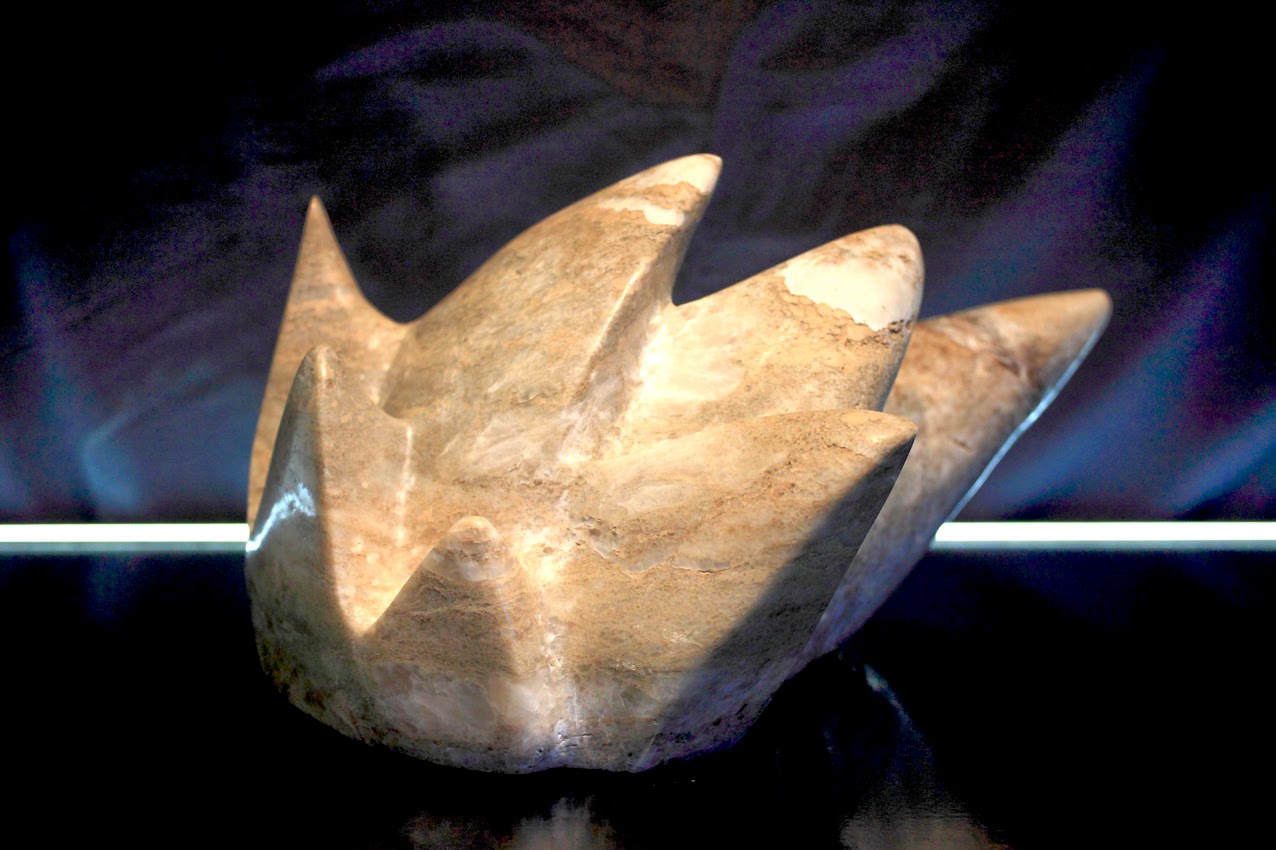
Untitled Alabaster 60 x 30 x 50 cm Mar - Jun. 2009
On my second year of Fine Arts, after finishing the Wooden Egg, I still had time to make another piece, so I decided to try working on stone. As I had never tried it
before I was advised to either work in sandstone or alabaster. I usually give a polished finish to my pieces, and sandstone does not really allow it, so I went for alabaster.
The piece's form was inspired by the shape of the bird's wings,
but the idea evolved a lot from the first drafts to the final shape. Working with alabaster proved to be easier than expected, altough tougher than wood. As I worked with hand tools, I either expected it to be really hard or too fragile, but I didn't have any problem. I also discovered that working with alabaster involves some luck, as each stone differs a lot from another and may have cracks or streaks, mine turned out to be a really white and pure alabaster which gave me no problems. As I got used with the new material, the challenge was to make the edges as sharp as posible and not to break them, and finally to polish it as much as possible.
This piece was chosen for a sculpture exhibition of different sculpture
artists from our faculty, named "Jovenes Artistas" (Young Arists), wich took place from
february to april of 2010 and made it to the media.
Untitled Birchwood 75 x 30 x 30 cm Nov. 2008 - Feb. 2009
The second "big piece" I made when I was at my second year of Fine Arts. Again, we had to make a sculpture, but this time we could choose between
stone or wood.
It doesn't have a concept, but starting from this piece, I've always tried to have a
challenge in each proyect I start, in order to learn more and surpass myself. That has become a theme in all my pieces since then, no matter the piece's concept, there is always a personal technical challenge.
This piece's challenge was to empty the egg without breaking it, I learnt that I could start the piece in several parts and then put them together. Also,making the whole piece stable by itself, and finish it faster as I also wanted to try stone sculpting.